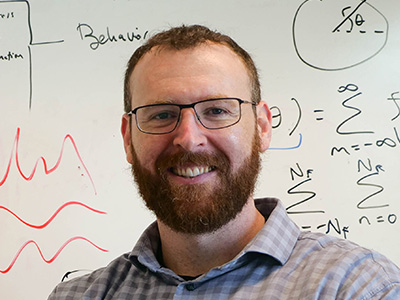
Staff Spotlight: John Fucillo, Building 68 Manager, EHS Coordinator; Chemical Hygiene Officer

Laying foundations for MIT Biology

Samantha Edelen | Department of Biology
May 2, 2024

Building 68 manager John Fucillo’s leadership, innovation, and laid-back attitude have built a community culture that will never be taken for granted. 

When entering the office of Building 68’s manager, you will likely be greeted first with an amiable nose boop and wagging tail from Shadow, a four-year-old black lab, followed by a warm welcome from the office’s other occupant, John Fucillo. Fucillo is an animal lover, and Shadow is the gentlest of roughly nine dogs and one Siamese cat he’s taken care of throughout his life. Fortunately for MIT Biology, Shadow is not the only lab Fucillo cares for. 

A Boston area local, Fucillo spent two years working at Revere Beach, then learned skills as an auto mechanic, and later completed an apprenticeship with the International Brotherhood of Electrical Workers. In 1989, Fucillo came to MIT Biology and says he couldn’t be happier.

As Building 68’s manager, Environment, Health & Safety coordinator, and Chemical Hygiene Officer, Fucillo’s goal is to make workflows “easier, less expensive, more desirable, and more comfortable.”

Fucillo was key for the Department’s successful move into its new home when Building 68 was completed in 1994, according to Mitchell Galanek, MIT Radiation Protection Officer and Fucillo’s colleague for over 30 years. 

Throughout his time as a building manager, Fucillo has decreased routine spending and increased sustainability. He lowered the cost of lab coats by a whopping 92%–from $2,600 to $200–with just one phone call to North Star, the building’s uniform/linens provider. Auditing the building’s plastic waste generation inspired the institute-wide MIT Lab Plastics Recycling Program, which now serves over 200 labs across campus. More than 50,000 lbs of plastic have been recycled in the last four years alone. 

“John is not a cog in the wheel, but an integral part of the whole system,” says Anthony Fuccione, Technical Instructor and Manager of the Biology Teaching lab.

Connecting and leading 

Fucillo says one of his favorite parts of the job is chatting with researchers and helping them achieve their goals. He reportedly clocks about 10,000 steps per day on campus, responding to requests from labs, collaborating with colleagues, and connecting Biology to the institute’s Environment, Health, & Safety office.

“John is called upon — literally and figuratively — morning, noon, and night,” says Whitehead Professor of Molecular Genetics Monty Krieger. “He has had to become an expert in so very many areas to support staff, faculty, and students. His enormous success is due in part to his technical talents, in part to his genuine care for the welfare of his colleagues, and in part to his very special and caring personality.” 

When MIT needed to comply with the EPA’s decree to improve safety standards across campus, Fucillo sat on the committees tasked with meeting those standards while avoiding undue burden on researchers, establishing the Environmental Health and Safety Management system in 2002.

“From a safety perspective, that was one of the most challenging things MIT had to go through–but it came out at the end a better, safer, place,” says John Collins, EHS Project Technician and friend and colleague to Fucillo for over 20 years.

Fucillo later co-led the initiative for a 2011 overhaul of MIT’s management of regulated medical waste (RMW), such as Petri dishes, blood, and needles. Fucillo volunteered to pilot a new approach in Building 68 — despite a lukewarm response to the proposal from other Biology EHS representatives, according to Galanek. This abundantly successful management system is now used by all MIT departments that generate RMW. It’s not only less expensive, but also does a better job at decontaminating waste than the previous management system.

“Anyone who has worked with John during his MIT career understands it is truly a privilege to partner with him,” Galanek says. “Not only does the work get done and done well, but you also gain a friend along the way.”

After consolidating a disparate group of individual lab assistants, Fucillo took on a supervisory role for the centralized staff tasked with cleaning glassware, preparing media, and ensuring consistency and sterility across Building 68 labs. 

According to maintenance mechanic James “Jimmy” Carr, “you can’t find a better boss.”

“He’s just an easy-going guy,” says Karen O’Leary, who has worked with Fucillo for over 30 years. “My voice matters–I feel heard and respected by him.” 

Looking forward

Although there are still many updates Fucillo hopes to see in Building 68, which will soon celebrate its 30th birthday, he is taking steps to cut back on his workload. 

He recently began passing on his knowledge to Facilities Manager and EHS Coordinator Cesar Duarte, who joined the department in 2023.

“It’s been a pleasure working alongside John and learning about the substantial role and responsibility he’s had in the Biology department for the last three decades,” Duarte says. “Not only is John’s knowledge of Building 68 and the department’s history unparalleled, but his dedication to MIT and continued care and commitment to the health and well-being of the Biology community throughout his career are truly remarkable.”

As he winds down his time at MIT, Fucillo hopes to spend more time on music, one of his earliest passions, which began when he picked up an accordion in first grade. He still plays guitar and bass nearly every day. When he rocks out at home more often, he’ll be leaving behind the foundations of innovation, leadership, and respect in Building 68.

New findings activate a better understanding of Rett syndrome’s causes

Rett syndrome is caused by mutations to the gene MECP2, which is highly expressed in the brain and appears to play important roles in maintaining healthy neurons. Researchers led by Rudolf Jaenisch have used cutting-edge techniques to create an epigenome map of MECP2, which may help guide future research on the disease.

Greta Friar | Whitehead Institute
April 25, 2024
Ragon faculty finds intricate functions of Resident Tissue Macrophages (RTM’s) extend beyond immune defense

The lab of Ragon Institute faculty @hernandezmsilva published a review in Science Immunology regarding resident tissue macrophages (RTMs), shedding light on these cells’ multifaceted roles.

April 15, 2024
The Whitehead Innovation Initiative is established to advance the use of artificial intelligence in biomedical research

The Whitehead Innovation Initiative launched in April 2024 and, under the expert guidance of President and Director Ruth Lehmannn, will pioneer the melding of AI and biology. The initiative was made possible by a $10 million gift from Michael and Victoria Chambers.

Merrill Meadow | Whitehead Institute
April 8, 2024
Unusual Labmates: Nature’s Peter Pans

Axolotls can regrow whole body parts, from tails and limbs to even parts of their brain and spine, making them fascinating research subjects, and their unique looks have been captured in art and culture in their native Mexico and beyond. Recently, Peter Reddien’s lab has added axolotls to their list of regenerative specimens with a research project led by graduate student Conor McMann.

April 4, 2024
Endowed Chairs fuel pioneering Whitehead Institute Science

Endowed chairs are generally created through philanthropic gifts from individual donors, organizations, or groups of donors honoring a specific person. The chairs — of which the Institute currently has five — provide steady, predictable funding to support investigations in Members’ labs, including: Whitehead Institute Member Iain Cheeseman, who — in addition to being a professor of biology at Massachusetts Institute of Technology (MIT) — holds the Margaret and Herman Sokol Chair in Biomedical Research; Yukiko Yamashita — Whitehead Institute Member, professor of biology at MIT, and Howard Hughes Medical Institute Investigator — the inaugural incumbent of the Susan Lindquist Chair for Women in Science; Jonathan Weissman — Professor of Biology and Whitehead Institute Core Member and HHMI Investigator — is the inaugural holder of the Landon T. Clay Professor of Biology Chair. In 2020, Mary Gehring — Professor of Biology, Graduate Officer, and Core Member of the whitehead Institute Core Member and David Baltimore Chair in Biomedical Research, Whitehead Institute was named the inaugural holder of the Clay Career Development Chair. In 2023, Gehring was succeeded by Sebastian Lourido, associate professor of Biology and Core Member of the Whitehead Institute.

April 2, 2024
Student spotlight: Victory Yinka-Banjo (6-7)

The junior, who is majoring in computer science and molecular biology, wants to “make it a norm to lift others as I continue to climb.”

March 27, 2024
Evolution in Action Series: Birth of a species

How do new species emerge over time? The Yamashita Lab studies the role of "junk" DNA in making two related species reproductively incompatible.

March 20, 2024
Video: Conversations with Scientists: Robert T. Sauer

Robert “Bob” Sauer, the Salvador E. Luria Professor of Biology, discusses his life leading up to joining MIT in the Department of Biology, the unconventional timing of acquiring his PhD, formative moments as a mentor, and how research approaches have changed since he joined the department.

March 21, 2024
3 Questions: Professors Adam Martin and Joel Volman on updating MIT’s undergraduate curriculum

Professors Adam Martin and Joel Volman explain the genesis, scope, and objectives of the recently launched Task Force on the MIT Undergraduate Academic Program.

Office of the Vice Chancellor
March 19, 2024

In late February, Vice Chancellor for Undergraduate and Graduate Education Ian A. Waitz and Faculty Chair Mary Fuller announced the formation and launch of the Task Force on the MIT Undergraduate Academic Program (TFUAP). The effort fulfills a critical recommendation of the Task Force 2021 and Beyond RIC1 (Undergraduate Program) and draws upon several, prior foundational working groups some focused on the current General Institute Requirements (GIRs) and others on updating recent studies for the purposes of this review.

In this interview, task force co-chairs Adam Martin, professor of biology, and Joel Voldman, the William R. Brody Professor of Electrical Engineering and Computer Science describe the TFUAP’s goals, approach, and next steps.

Q: The charge of the task force is quite ambitious, including “reviewing the current undergraduate academic program and considering improvements with a focus on both the curriculum and pedagogy.” Can you explain your approach?

Martin: For context, it’s important to know that the undergraduate program is multifaceted and consists of many components, including majors, electives, experiential learning, and of course the GIRs arguably one of the best-known acronyms at MIT! Moreover, the GIRs include science core classes; humanities, arts, and social sciences classes; certain electives in science and engineering; and a lab requirement, each of which serves a slightly different purpose and dovetails with majors and minors in unique ways.

Some aspects of the academic program are determined by the faculty, either MIT-wide or within a particular department. Others can be customized by students, in consultation with faculty and staff advisors, from the broad array of curricular and co-curricular offerings at MIT. The task force will look holistically at all of these aspects, considering both what MIT requires of all students, and the options we make available as students chart their own paths.

As part of this holistic approach, the TFUAP will zero in on both content and pedagogy. Obviously, the content we cover is important; our goal must remain to provide undergraduates with the world-class education they expect. But how we teach is of fundamental importance, as well. The pedagogy we adopt should be inclusive, supported by research, and designed to help students not only understand what they are learning, but why they are learning it how it relates to their majors, potential careers, and their lives.

Voldman: I think your question’s description of our charge as “ambitious” is noteworthy. We feel that the task force is ambitious, too, but perhaps in a different sense from the question. That is, we believe our job is to not only think about nuts-and-bolts issues of the academic program requirements but also to consider the big picture. What are the most expansive possibilities? How can we push the envelope? That’s the MIT way, after all.

Q: The task force is building upon quite a bit of past work and benefits from some major accomplishments recommended by Task Force 2021 (TF2021). For example, how does the creation of the Undergraduate Advising Center, and in general, the desire to provide more personal and professional support to all students, fit in with the potential updates to the undergraduate curriculum?

Martin: You’re absolutely right our work benefits greatly from years of conversations focused on the undergraduate academic program, particularly in the last decade or so. These include the 2014 Task Force on the Future of Education; the 2018 Designing the First-Year Experience Class; Task Force 2021 and Beyond (TF2021); the Foundational Working Groups (part of the RIC 1 implementation) that have studied the existing MIT undergraduate program; and the Committee on the Undergraduate Program. The valuable work of these past committees and their findings will certainly inform our thought process.

In the past, groups that evaluated the undergraduate curriculum were also charged with tackling related topics, such as undergraduate advising or revamping classrooms. Taking on any one of these three issues is ambitious by any measure! What’s changed in the past decade is that advances have been made in these other critical areas, so the TFUAP can focus solely on curriculum and pedagogy. For example, thanks to recent accomplishments by TF2021 and others, we have implemented a new advising system for all undergraduates in the form of the Undergraduate Advising Center.

We envision the TFUAP being a highly collaborative process, bringing in voices across the entire Institute and beyond. We welcome input from members of the community via email at tfuap@mit.edu. We will also be reaching out to student groups, alumni, individual faculty, faculty groups, and administrative staff across the Institute to hear their perspectives.

Q: Part of what TFUAP will have to confront, no doubt, are some of the most pressing issues of our time, like the rise of computing and AI, climate change (what President Kornbluth calls an existential threat to our way of life), and the changing nature of learning (online, hybrid, etc.). How are you thinking about all of these factors?

Voldman: That is a good question! It’s early days, and our work is just beginning, but we know that these and other issues loom over all of us. For example, we are keenly aware of the influx of students into computing-related majors and classes, and we need to think deeply about the implications. Furthermore, we want a curriculum that prepares students for current and upcoming global challenges as well as changes in the technology and tools available to address those challenges. However, we can expect that our students will need to be agile and curious, lifelong learners, collaborative and compassionate teammates, and creative and thoughtful problem-solvers.

As we work with the community to design the next version of an MIT undergraduate education, it will be important to build a structure that can incorporate the biggest challenges and opportunities of the day, while staying flexible and responsive to an ever-evolving world.