
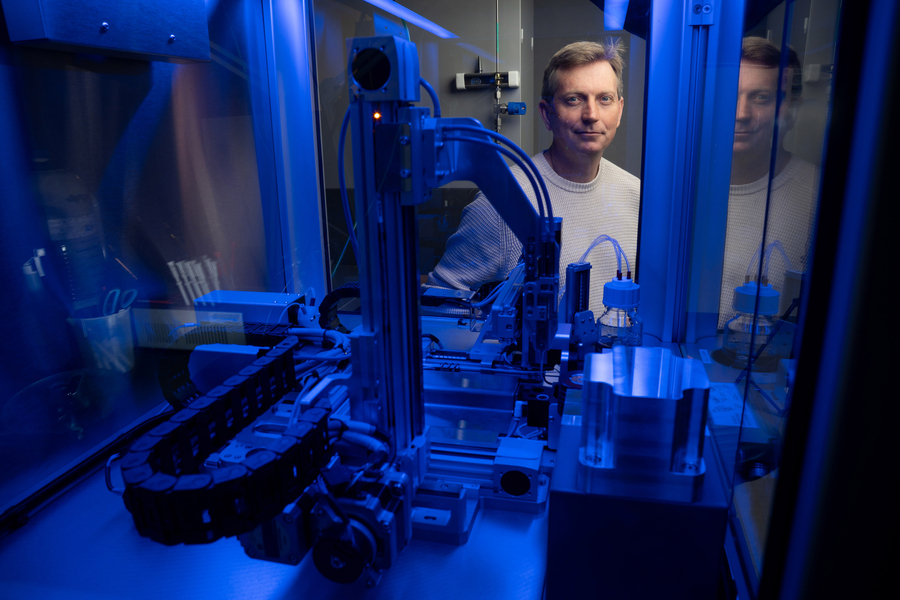
Biologist Joey Davis explores how cells build complex structures

His studies have shed light on the assembly instructions that govern ribosomes, the critical protein-building machines of the cell.

Anne Trafton | MIT News
May 5, 2026

Ribosomes, the cellular machines that assemble proteins, are made from dozens of proteins and RNA molecules. Putting all of those pieces together is a complex puzzle — one that MIT Associate Professor Joey Davis PhD ’10 revels in trying to solve.

Understanding how these structures form and later break down could help researchers learn more about how disruptions of these fundamental processes can lead to disease. But, as Davis points out, it’s also an interesting biological question.

“Our long-term goal is to really understand how the natural world assembles these huge complexes rapidly and efficiently. It’s a fundamentally interesting question to think about how these things get put together,” he says.

His work has helped reveal that unlike building a house, which happens in a prescribed sequence of steps — pouring the foundation, building the frame, putting on the roof, then doing electrical and plumbing work — ribosomes can be assembled in a more flexible way. Cells can even skip an assembly step and then come back to it later.

“In these natural systems, it seems like the assembly pathways are much more dynamic and flexible,” he says. “It appears that evolution has selected pathways that aren’t strictly ordered in the way we would think about an assembly line, where you always put in one component, then the next, and then the next. We’re excited to understand the selective advantages of such approaches.”

A love of discovery

Davis’ interest in how things are put together developed early in life, inspired by his father, a carpenter who framed houses. During the mid-1980s, the family moved from Colorado to Southern California, where his father worked in construction during a housing boom there.

“I was always interested in building things, which I think probably came from being around my dad and other builders,” Davis says.

As an undergraduate at the University of California at Berkeley, where he majored in computer science and biological engineering, Davis’ interests turned toward smaller scales, in the realm of cells and molecules. During his junior year, he started working in the lab of chemistry professor Michael Marletta, who studies molecular-level biological interactions.

In the lab, Davis investigated how enzymes that contain heme are able to preferentially bind to either oxygen or nitric oxide, two gases that are very similar in structure. That work kindled a love of studying the natural world and pursuing discoveries in fundamental science.

“Being in the Marletta lab and seeing students and postdocs that were really passionate about these problems had a big impact on me,” Davis says. “The goal was to understand the fundamentals of how molecular discrimination works, and the idea of discovery for the sake of discovery was thrilling.”

After graduating from Berkeley, Davis spent another year working in Marletta’s lab, and then a year working odd jobs, before heading to MIT to pursue a PhD in biology. There, he worked with Professor Bob Sauer, now emeritus, who studied the relationship between protein structure and function, with a particular focus on the molecular machines that degrade or remodel proteins.

Davis’ thesis research centered on enzymes called AAA proteases, which remove damaged proteins from cellular membranes and send them to cell organelles that break them down. In addition to studying the structure and function of the proteases, Davis worked on ways to engineer them to tag specific proteins for destruction.

That work led him into synthetic biology, which he used to develop genetic parts that drive production of proteins of interest. Some of those parts ended up being used by the biotech startup Ginkgo Bioworks, where Davis took a job as a senior scientist after graduating.

Working at Ginkgo Bioworks allowed Davis to stay in Boston while his partner finished her PhD. The couple then moved back to California, where Davis worked as a postdoc at Scripps Research, which was home to one of the first direct electron detection cameras for cryo-electron microscopy (cryo-EM). These detectors allow researchers to generate structures with near atomic resolution. At Scripps, Davis began using them to study ribosomes as they were being assembled.

Peering into the ribosome

After joining the MIT faculty in 2017, Davis continued his work on ribosomes and assembled a lab group that includes students from a variety of backgrounds who work together to develop new ways to explore biological phenomena.

“I have a mix of method developers and biologists in the group, and the work from each of them informs each other,” Davis says. “My lab goes back and forth between building sets of tools to answer biological questions, and then as we’re answering those questions, it motivates the next generation of tool development.”

During ribosome assembly, RNA molecules fold themselves into the correct shapes, creating docking sites for proteins to attach. Then, more RNA molecules come in and fold themselves into the structure.

“It’s a beautifully coupled process by which the cell folds hundreds of RNA helices and binds on the order of 50 proteins, and it does it in two minutes from start to finish. E. coli does this 100,000 times per hour, and it’s amazing how rapid and efficient the process is,” Davis says.

Cryo-EM allows scientists to capture this process in minute detail. It can be used to take hundreds of thousands of two-dimensional images of ribosome samples frozen in a thin layer of ice, from different angles. Computer algorithms then piece together these images into a three-dimensional representation of the ribosome.

To gain insight into how ribosomes are assembled, researchers can stall the process at different points and then analyze the resulting structures. In 2021, Davis’s lab developed a new method called CryoDRGN, which uses neural networks to analyze cryo-EM data and generate the full ensemble of structures that were present in the sample.

This work has shown that when certain steps of ribosome assembly are blocked, many different structures result, suggesting that the assembly can occur in a variety of ways.

In future work, Davis aims to dramatically increase the throughput of cryo-EM to generate datasets of protein structures that could help improve the AI-based models that are now used to predict protein structures.

“There are still huge swaths of sequence space that these models are very poor at predicting, but if we could collect data on those sequences en masse, that could potentially serve as key training data for a next-generation protein structure prediction method that could fill out that space,” he says.
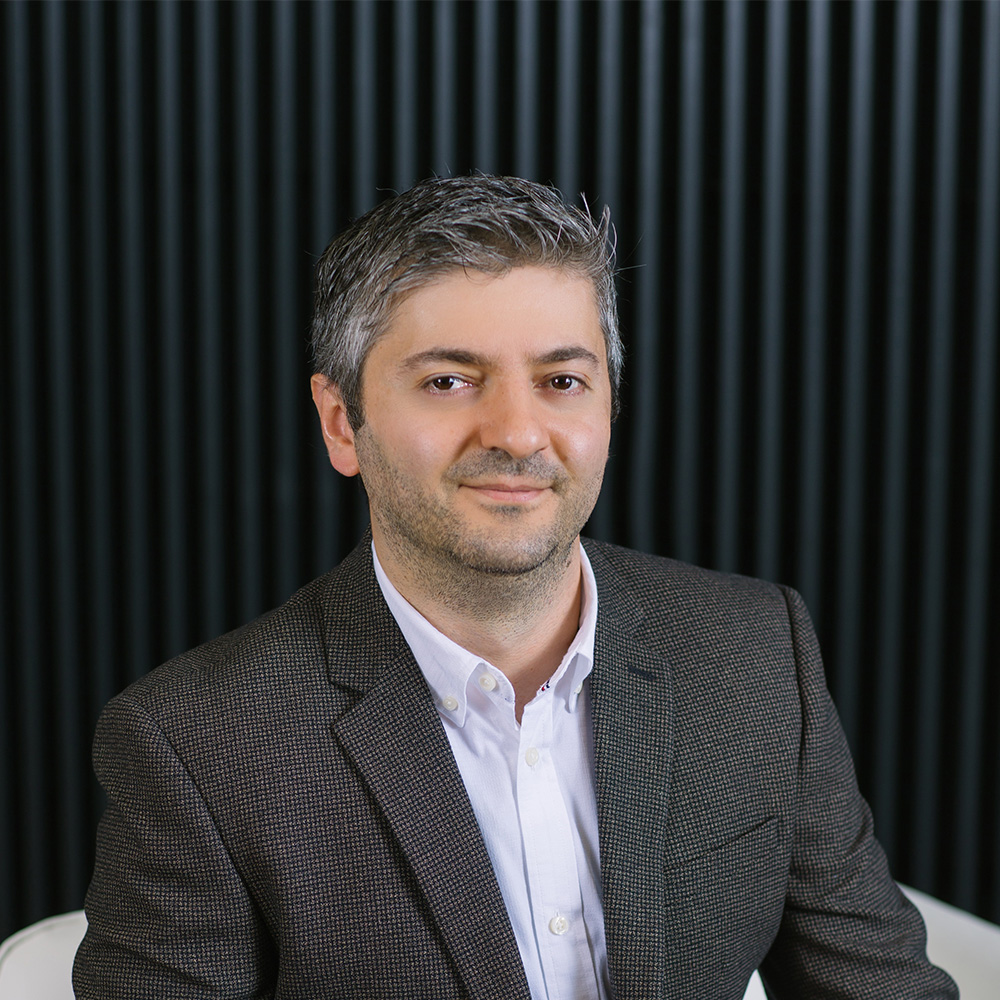
Alum Profile: Gevorg Grigoryan, PhD ’07

Creating the Crossroads

Lillian Eden | Department of Biology
June 13, 2024

From academia to industry, at the intersection of computation, biology, and physics, Gevorg Grigoryan, PhD ’07, says there is no right path–just the path that works for you

A few years ago, Gevorg Grigoryan, PhD ‘07, then a professor at Dartmouth, had been pondering an idea for data-driven protein design for therapeutic applications. Unsure how to move forward with launching that concept into a company, he dug up an old syllabus from an entrepreneurship course he took during his PhD at MIT and decided to email the instructor for the class. 

He labored over the email for hours. It went from a few sentences to three pages, then back to a few sentences. Grigoryan finally hit send in the wee hours of the morning. 

Just 15 minutes later, he received a response from Noubar Afeyan, PhD ’87, the CEO and co-founder of venture capital company Flagship Pioneering (and the commencement speaker for the 2024 OneMIT Ceremony)

That ultimately led to Grigoryan, Afeyan, and others co-founding Generate:Biomedicines, where Grigoryan now serves as CTO.

“Success is defined by who is evaluating you,” Grigoryan says. “There is no right path—the best path for you is the one that works for you.” 

Generalizing Principles and Improving Lives

Generate:Biomedicines is the culmination of decades of advancements in machine learning, biological engineering, and medicine. Until recently, de novo design of a protein was extremely labor intensive, requiring months or years of computational methods and experiments. 

“Now, we can just push a button and have a generative model spit out a new protein with close to perfect probability it will actually work. It will fold. It will have the structure you’re intending,” Grigoryan says. “I think we’ve unearthed these generalizable principles for how to approach understanding complex systems, and I think it’s going to keep working.” 

Drug development was an obvious application for his work early on. Grigoryan says part of the reason he left academia—at least for now—are the resources available for this cutting-edge work.  

“Our space has a rather exciting and noble reason for existing,” he says. “We’re looking to improve human lives.”

Mixing Disciplines

Mixed-discipline STEM majors are increasingly common, but when Grigoryan was an undergraduate at the University of Maryland Baltimore County, little to no infrastructure existed for such an education.  

“There was this emerging intersection between physics, biology, and computational sciences,” Grigoryan recalls. “It wasn’t like there was this robust discipline at the intersection of those things—but I felt like there could be, and maybe I could be part of creating one.” 

He majored in Biochemistry and Computer Science, much to the confusion of his advisors for each major. This was so unprecedented that there wasn’t even guidance for which group he should walk with at graduation. 

Heading to Cambridge

Grigoryan admits his decision to attend MIT in the Department of Biology wasn’t systematic. 

“I was like ‘MIT sounds great, strong faculty, good techie school, good city. I’m sure I’ll figure something out,’” he says. “I can’t emphasize enough how important and formative those years at MIT were to who I ultimately became as a scientist.”

He worked with Amy Keating, then a junior faculty member, now Department Head for the Department of Biology, modeling protein-protein interactions. The work involved physics, math, chemistry, and biology. The Computational and Systems Biology PhD program was still a few years away, but the developing field was being recognized as important. 

Keating remains an advisor and confidant to this day. Grigoryan also commends her for her commitment to mentoring while balancing the demands of a faculty position—acquiring funding, running a research lab, and teaching. 

“It’s hard to make time to truly advise and help your students grow, but Amy is someone who took it very seriously and was very intentional about it,” Grigoryan says. “We spent a lot of time discussing ideas and doing science. The kind of impact that one can have through mentorship is hard to overestimate.”

Grigoryan next pursued a postdoc at UPenn with William “Bill” DeGrado, continuing to focus on protein design while gaining more experience in experimental approaches and exposure to thinking about proteins differently. 

Just by examining them, DeGrado had an intuitive understanding of molecules—anticipating their functionality or what mutations would disrupt that functionality. His predictive skill surpassed the abilities of computer modeling at the time. 

Grigoryan began to wonder: could computational models use prior observations to be at least as predictive as someone who spent a lot of time considering and observing the structure and function of those molecules?

Grigoryan next went to Dartmouth for a faculty position in computer science with cross-appointments in biology and chemistry to explore that question. 

Balancing Industry and Academia

Much of science is about trial and error, but early on, Grigoryan showed that accurate predictions of proteins and how they would bind, bond, and behave didn’t require starting from first principles. Models became more accurate by solving more structures and taking more binding measurements. 

Grigoryan credits the leaders at Flagship Pioneering for their initial confidence in the possible applications for this concept—more bullish, at the time, than Grigoryan himself. 

He spent four years splitting his time between Dartmouth and Cambridge and ultimately decided to leave academia altogether. 

“It was inevitable because I was just so in love with what we had built at Generate,” he says. “It was so exciting for me to see this idea come to fruition.” 

Pause or Grow

Grigoryan says the most important thing for a company is to scale at the right time, to balance “hitting the iron while it’s hot” while considering the readiness of the company, the technology, and the market. 

But even successful growth creates its own challenges. 

When there are fewer than two dozen people, aligning strategies across a company is straightforward: everyone can be in the room. However, growth—say, expanding to 200 employees—requires more deliberate communication and balancing agility while maintaining the company’s culture and identity.

“Growing is tough,” he says. “And it takes a lot of intentional effort, time, and energy to ensure a transparent culture that allows the team to thrive.” 

Grigoryan’s time in academia was invaluable for learning that “everything is about people”—but academia and industry require different mindsets. 

“Being a PI is about creating a lane for each of your trainees, where they’re essentially somewhat independent scientists,” he says. “In a company, by construction, you are bound by a set of common goals, and you have to value your work by the amount of synergy that it has with others, as opposed to what you can do only by yourself.”