Combatting chemotherapy resistance

Graduate student Faye-Marie Vassel investigates a protein that helps cells tolerate DNA damage, sharing her expertise with budding scientists to further STEM education

Raleigh McElvery
December 8, 2017

Combatting chemotherapy resistance

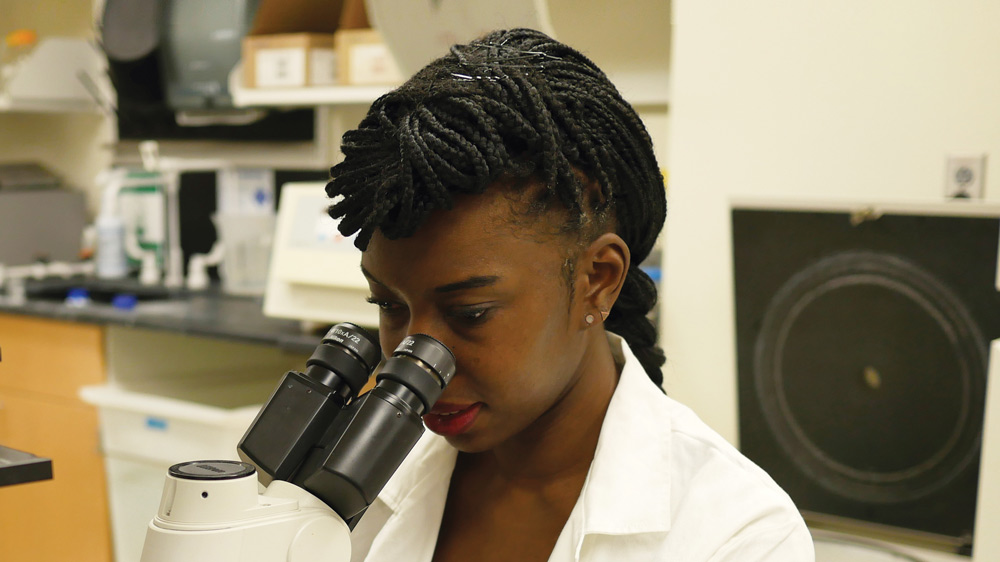
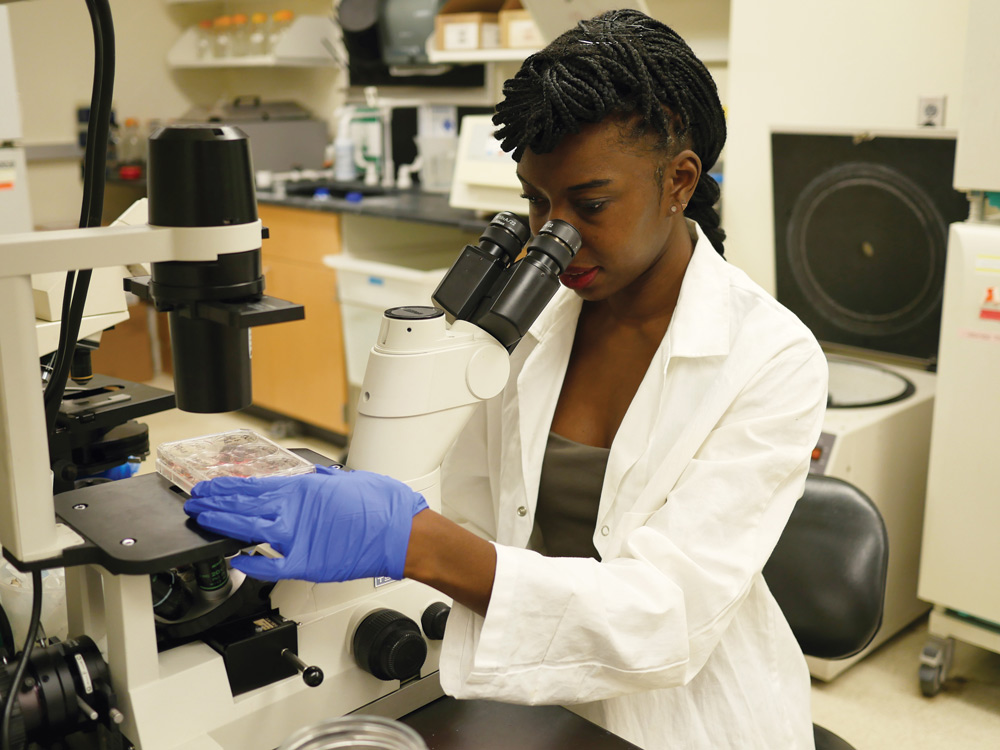
Person with long, dark hair and lab coat stares into microscope.

Graduate student Faye-Marie Vassel investigates a protein that helps cells tolerate DNA damage, sharing her expertise with budding scientists to further STEM education

Raleigh McElvery


Faye-Marie Vassel has a protein. Well, as a living entity, technically she has many, but just one she affectionately refers to as her own. “My protein, REV7.” And it makes sense — if you were hard at work characterizing a single protein for all six years of your graduate career, you’d be pretty attached, too. Plus, the stakes are high. REV7, which aids in DNA damage repair, could ultimately provide insight into ways to combat chemotherapy resistance.

Although Vassel’s mother trained as an OB/GYN in Russia before moving to the U.S., serving as what Vassel describes as a “quiet” scientific role model, Vassel spent her early childhood emulating her father, a social worker, and engrossed in the social sciences. She intended to one day work in science policy — until high school when she joined an after-school program at the American Museum of Natural History in New York City, and discovered an additional interest.

Here, Vassel took a series of molecular biology classes and met her first female research mentor, a postdoctoral fellow at Rockefeller University, who encouraged her to participate in another, more advanced science program funded by the National Science Foundation.

“I initially had my doubts, but just having that support changed everything,” Vassel says. “That was my first time doing research of any kind, and I got a sense of the sheer diversity of potential research projects. That’s also when I heard there was something called biophysics.”

From that point on, Vassel was hooked. As an undergraduate at Stony Brook University, she initially declared a major in physics before switching to biochemistry. Later, when it came time to select a graduate school, she was split between MIT and the University of California, Berkeley. As she recalls, MIT’s graduate preview weekend made all the difference.

“I had the chance to stay with biology students and speak with professors,” she says. “The whole experience made the department seem personal, and demystified the graduate school process by making it more tangible.”

She proposed a joint position between two labs: Graham Walker’s lab, based in Building 68, and Michael Hemann’s lab situated in the Koch Institute for Integrative Cancer Research. Walker’s lab focuses on microbiology, DNA repair, and antibiotic resistance, while Hemann’s lab investigates chemotherapy resistance in hopes of improving cancer therapies. After stumbling upon one of their joint papers, Vassel decided she’d like to combine the two.

“It’s invaluable to have both perspectives,” she says. “Mike’s lab just celebrated its 10th anniversary, while Graham‘s just had its 35th. It’s been interesting seeing the different ways they approach their respective research questions, because they were trained in such different scientific eras.”

Although Vassel is currently the only student formally working in both labs, the collaboration between Walker and Hemann, aimed at combatting chemotherapy resistance, has been ongoing.

Frontline chemotherapies, including one anticancer agent called cisplatin, kill cancer cells by damaging their DNA and preventing them from synthesizing new genetic material. Just how sensitive cancer cells are to cisplatin — and therefore how effective the treatment is — depends on whether the cell can repair the damage and bypass DNA-damage induced cell death. In some cases, cells increase production of “translesion polymerases,” which are specialized DNA polymerases that can help cells tolerate certain kinds of DNA damage by synthesizing across from damaged DNA or DNA bound to a carcinogen.

Vassel’s protein, REV7, is a structural subunit of one key translesion polymerase, and its expression is deregulated in many different cancer cells. As Vassel suggests, if one aspect of these translesion polymerases — say, the REV7 subunit — could be altered to hinder repair, then perhaps cancer-ridden cells could regain drug sensitivity.

Thanks to recently-developed CRISPR-Cas9 gene editing techniques, Vassel has removed REV7 entirely from drug resistant lung cancer cellsand watched as cisplatin sensitivity was restored. She also conducted rescue experiments, adding REV7 back into cell lines lacking the protein to see whether those cells become resistant to the drug once again. Most recently, she has been working in murine models to see whether REV7 has similar effects in a living system.

If her hypothesis is correct, REV7 would be a powerful target for drug development. Treatments that inhibit REV7, she explains, could be used in tandem with frontline chemotherapies like cisplatin to prevent resistance.

Since her foray into biology at the American Museum of Natural History almost a decade ago, Vassel has maintained her passion for science outreach. During her time at MIT, she has served as a math tutor for middle schoolers in the Cambridge public school system. She also volunteered as a science and math mentor for high school students, as part of a dual athletic and academic program founded by MIT.

As Vassel wraps up her final year of graduate studies, she is torn between completing an academic postdoc and indulging her early interest in science education policy.

“Growing up in New York City, it was not lost on me that — despite the city’s wonderful diversity — people from historically underserved groups were still missing from many science-related positions,” Vassel says. “It got me thinking about the dire need for policymakers to improve curricula to make science more inclusive of all life experiences. There’s this idea that science is apolitical when it’s really not, and that mindset can have detrimental effects on equity and diversity in science.”

Photo credit: Raleigh McElvery
Tania A. Baker

Education

  • PhD, 1988, Stanford University
  • BS, 1983, Biochemistry, University of Wisconsin-Madison

Research Summary

Our goal is to understand the mechanisms and regulation behind AAA+ unfoldases and macromolecular machines from the “Clp/Hsp100 family” of protein unfolding enzymes. We study these biological catalysts using biochemistry, structural biology, molecular biology, genetics, and single molecule biophysics.

No longer accepting students.

Awards

  • Margaret MacVicar Faculty Fellow, 2008-2018
  • National Academy of Sciences, Member, 2007
  • American Academy of Arts and Sciences, Fellow, 2005
  • Howard Hughes Medical Institute, HHMI Investigator, 1994
Celebrating a decade of interdisciplinary microbiology

The Microbiology Graduate PhD Program spans 50 labs across 10 departments and divisions, offering a broad approach to microbial science and engineering.

Raleigh McElvery | Department of Biology
December 12, 2017

Ten years ago, MIT launched the Microbiology Graduate PhD Program. Today, it boasts 28 alumni and 33 current students, and offers a broad, interdisciplinary approach to microbial science and engineering. Between five and eight trainees enroll each year and can choose among more than 50 labs spanning 10 departments and divisions — from biology and biological engineering to chemical engineering and physics.

Many diverse disciplines are rooted in microbiology. Basic scientists use microorganisms as model systems to understand fundamental biological processes. Engineers leverage microorganisms to create new manufacturing processes and energy sources. Even ecologists, biomedical researchers, and earth scientists dedicate their careers to investigating the role of microbes in our ecosystems, on our bodies, and on our planet. In sum, the study of microbiology permeates so many research areas that no single department at MIT could house them all.

The idea for an interdisciplinary microbiology program first came to Alan Grossman, head of the Department of Biology, while he was recovering from a heart transplant back in 2006.

“There were people scattered all over MIT who were doing microbial science and engineering, but there was no mechanism to connect them or give students outside those departments easy access to the labs,” Grossman says. “I began by talking to a few faculty members in order to gauge general interest, before pitching it to a handful of department heads and forming a committee. Everyone was very excited about it, and it really grew from the ground up.”

The Committee on Graduate Programs approved his proposal in May 2007, and the first cohort of eight students began in the fall of 2008. Martin Polz, co-director since 2015 and professor of civil and environmental engineering, sat on Grossman’s initial committee.

“MIT’s program is unique from most other microbiology programs because it’s so interdisciplinary,” Polz says. “Many microbiology programs across the country are associated with medical schools and focused primarily on pathogenesis. The students who apply here really appreciate the breadth of our program, and it has become a fixture at MIT over the years.”

Kristala Prather, co-director since 2013 and professor of chemical engineering, said the program also provides an opportunity to bring life scientists and engineers together to tackle research questions.

“I find there is a difference in the way engineers and scientists approach research problems,” Prather says. “Each approach has rigor, but having both perspectives breeds a richer set of discussions than just hearing from one discipline alone.”

During the past 10 years, Prather has watched a thriving and diverse community unite, spurred by a common interest in the microbial world.

Nathaniel Chu, who matriculated in 2014, said the program allows him to sample different disciplines while still maintaining a close affiliation with his advisor’s home department, Biological Engineering. As part of Eric Alm’s lab, Chu studies the interaction between the gut microbiome and immune system, and how imbalances in that delicate relationship can trigger conditions such as Type 2 diabetes, obesity, and inflammatory bowel disease.

“The program provides flexibility to explore your research interests, and my advisor has given me a lot of space to conceive and manage my own projects,” Chu says. “I’ve been able to interact with a diverse set of individuals within the microbiology circle, including clinical partners, immunologists, geneticists, bioinformaticians, and computational biologists.”

Jacquin Niles, incoming co-director, was a junior faculty member in Department of Biological Engineering when Grossman first proposed the idea. He says the students — past and present — are the heart of the program.

“A lot has changed over the 10 years the program has been in existence, but the caliber of students has remained consistent,” Niles says. “If I had to emphasize any particular aspect of the program, the students would be numbers one, two, and three. Each generation has been exceptional, and they are all very much on top of their research game.”

Michael Laub, co-director from 2012 to 2015 and professor of biology, adds that the early students deserve much credit for the program’s success. “They took a chance on a brand-new initiative, and as a result we ended up attracting ambitious, risk-taking, and creative folks who really paved the way for current students,” he says.

Alumni pursue a variety of careers, ranging from academia to industry. Some join existing institutions or companies. Others start their own.

Mark Smith PhD ’14 was a member of the second graduating class. Like Chu, he was one of Alm’s advisees, studying networks of gene exchange within the human microbiome, and building statistical models to determine the role of environment in various gut-related diseases. Smith went on to co-found a nonprofit organization known as OpenBiome, harnessing the microbiome to cure recurrent Clostridium difficile infections. In 2016, he co-founded another company, Finch Therapeutics Group, focused on scaling and commercializing clinical treatments for diseases rooted in the microbiome. In 2017, he was named to the Forbes 30 Under 30 list for science.

“OpenBiome and Finch Therapeutics were really a translation of the initial work that was done through the microbiology program, and a step toward developing those tools to improve human health,” Smith says. “The program taught me the foundational work I’ve come to rely on in almost every aspect of my job today.”

Like Smith, Jacob Rubens PhD ’16 aims to apply his training at MIT to help develop new products. After working in Timothy Lu’s lab — straddling the realms of biological engineering and electrical engineering — Rubens joined Flagship Pioneering, a company that starts, funds, and runs breakthrough biotechnology startups in Cambridge, Massachusetts. Rubens was also named to the Forbes 30 Under 30 list for science in 2017.

During the six years that Rubens was at MIT, he watched the microbiology cohort grow from roughly 20 to a force permeating more labs across campus than he could count.

“It’s heartwarming to see people bringing a microbiological perspective into all these different spaces, and influencing cutting-edge research across the Institute,” he says. “As a microbiology student, you become an integrator and synthesizer of many different viewpoints, and a node to foster cross-talk between disciplines.”

As Niles prepares to assume the role of co-director in July 2018 and usher in the program’s second decade, he intends to maintain its integrity and structure.

“The program has matured into what it is today thanks to a lot of previous, careful thought,” he says. “The students have indicated that there is a lot of value in the structure that we’ve refined over the years, and so my goal is to continue that positive momentum.”

Michael T. Laub

Education

  • PhD, 2002, Stanford University
  • BS, 1997, Molecular Biology, University of California, San Diego

Research Summary

We study the biological mechanisms and evolution of how cells process information to regulate their own growth and proliferation. Using bacteria as a model organism, we aim to elucidate the detailed molecular basis for this remarkable regulatory capability, and understand the selective pressures and mechanisms that drive the evolution of signaling pathways. Our work is rooted in a desire to develop a deeper, fundamental understanding of how cells function and evolve, but it also has important medical implications since many signaling pathways in pathogenic bacteria are needed for virulence.

Awards

  • Howard Hughes Medical Institute, HHMI Investigator, 2015
  • National Science Foundation, Presidential Early Career Award for Scientists and Engineers, 2010
  • Howard Hughes Medical Institute, Early Career Scientist, 2009
Gene-Wei Li

Education

  • PhD, 2010, Harvard University
  • SB, 2004, Physics, National Tsinghua University

Research Summary

We seek to understand the optimization of bacterial proteomes at both mechanistic and systems levels. Our work combines high-precision assays, genome-wide measurements, and quantitative/biophysical modeling. Ongoing projects focus on the design principles of transcription, translation, and RNA maturation machineries in the face of competing cellular processes.

Awards

  • Smith Odyssey Award, 2020
  • MIT Committed to Caring Award, 2020
  • NSF Career Award, 2019
  • Pew Biomedical Scholar, 2017
  • Smith Family Award for Excellence in Biomedical Research, 2017
  • NIGMS R35 Maximizing Investigator Research Award, 2017
  • Sloan Research Fellowship, 2016
  • Searle Scholar, 2016
  • NIH Pathway to Independence Award, 2013
Sebastian Lourido

Education

  • PhD, 2012, Washington University in St. Louis
  • BS, 2004, Cellular and Molecular Biology and Studio Art, Tulane University

Research Summary

Our lab is interested in the molecular events that enable apicomplexan parasites to remain widespread and deadly infectious agents. We study many important human pathogens, including Toxoplasma gondii, to model features conserved throughout the phylum. We seek to expand our understanding of eukaryotic diversity and identify specific features that can be targeted to treat parasite infections.

Awards

  • Odyssey Award, Smith Family Foundation, 2021
Graham C. Walker

Education

  • PhD, 1974, University of Illinois
  • BS, 1970, Chemistry, Carleton University

Research Summary

Our research is concentrated in two major areas. First, we aim to understand how the proteins involved in DNA repair, mutagenesis and other cellular responses to DNA damage are regulated. Some of our discoveries have the potential to improve chemotherapy. Second, we probe how nitrogen-fixing nodules develop on legumes, and the relationship between rhizobial functions required for nodule invasion/infection and mammalian pathogenesis.

Awards

  • Revolutionizing Innovative, Visionary Environmental health Research (RIVER), R35 Outstanding Investigator Award, 2017
  • National Academy of Sciences, Member, 2013
  • Howard Hughes Medical Institute, HHMI Professor, 2010
  • University of Guelph, Doctor of Science, honoris causa, 2010
  • American Association for the Advancement of Science, Fellow, 2008
  • Environmental Mutagen Society, EMS Award, 2006
  • American Academy of Arts and Sciences, Fellow, 2004
  • American Cancer Society, Research Professor, 2002
  • Howard Hughes Medical Institute, HHMI Professor, 2002
  • Charles Ross Scholar, 2000-2003
  • American Academy of Microbiology, Fellow, 1994
  • Margaret MacVicar Faculty Fellow, 1992-2002
  • John Simon Guggenheim Memorial Foundation, Guggenheim Fellowship, 1984
  • Massachusetts Institute of Technology, MacVicar Faulty Fellow, 1984
  • Rita Allen Foundation, Career Development Award, 1978
Barbara Imperiali

Education

  • PhD, 1983, MIT
  • BSc, 1979, Medicinal Chemistry, University College London

Research Summary

We study diverse aspects of protein structure and function and employ multidisciplinary approaches to address fundamental problems at the interface of chemistry and biology. We are fascinated by the amazing complexity and myriad functions of glycoconjugates in human health and disease. Still more enthralling are the intricate membrane-associated pathways that lead to the cellular biogenesis of these important macromolecules. Our group applies approaches and technologies from a wide range of synergistic fields including chemical biology (for inhibitor and probe development), biochemistry and biophysics (for analyses within and beyond native and model membranes), and cellular, molecular and microbiology to unravel these pathways. Ultimately we seek to decipher the molecular logic of glycoconjugate biosynthesis and to identify processes to target in the study of infectious disease.

Awards

  • National Academy of Sciences, Member, 2010
  • Fellow of the Royal Society of Chemistry (FRSC) 2006
  • American Chemical Society – Breslow Award for Achievement in Biomimetic Chemistry 2006
  • Protein Society – Kaiser Award, 2006
  • Margaret MacVicar Faculty Fellow, 2003-2013
  • American Academy of Arts and Sciences, Fellow, 2001
Rebecca Lamason

Education

  • PhD, 2011, The Johns Hopkins University School of Medicine
  • BS, 2002, Molecular Biology and Biotechnology, Millersville University

Research Summary

In the Lamason lab, we investigate how intracellular bacterial pathogens hijack host cell processes to promote infection. In particular, we study how Rickettsia parkeri and Listeria monocytogenes move through our tissues via a process called cell-to-cell spread. We utilize cellular, molecular, genetic, biochemical and biophysical approaches to elucidate the mechanisms of spread in order to reveal key aspects of pathogenesis and host cell biology.

Awards

  • NIH Pathway to Independence Award, 2015
Joseph (Joey) Davis

Education

  • PhD, 2010, MIT
  • BA,  2003, Computer Science, University of California, Berkeley
  • BS, 2003, Biological Engineering, University of California, Berkeley

Research Summary

The Davis lab is working to uncover how cells construct and degrade complex molecular machines rapidly and efficiently. We apply a variety of biochemical, biophysical, and structural approaches including quantitative mass spectrometry and single particle cryo-electron microscopy to understand the detailed molecular mechanisms of these processes. Ongoing projects in the lab are focused on autophagy, an essential eukaryotic protein and organelle degradation pathway, and assembly of the ribosome, which is essential in all cells.

Awards

  • Sloan Research Fellowship, Alfred P. Sloan Foundation, 2021
  • National Institute on Aging R00 Fellowship, 2017
  • National Institute on Aging K99 Fellowship, 2015