
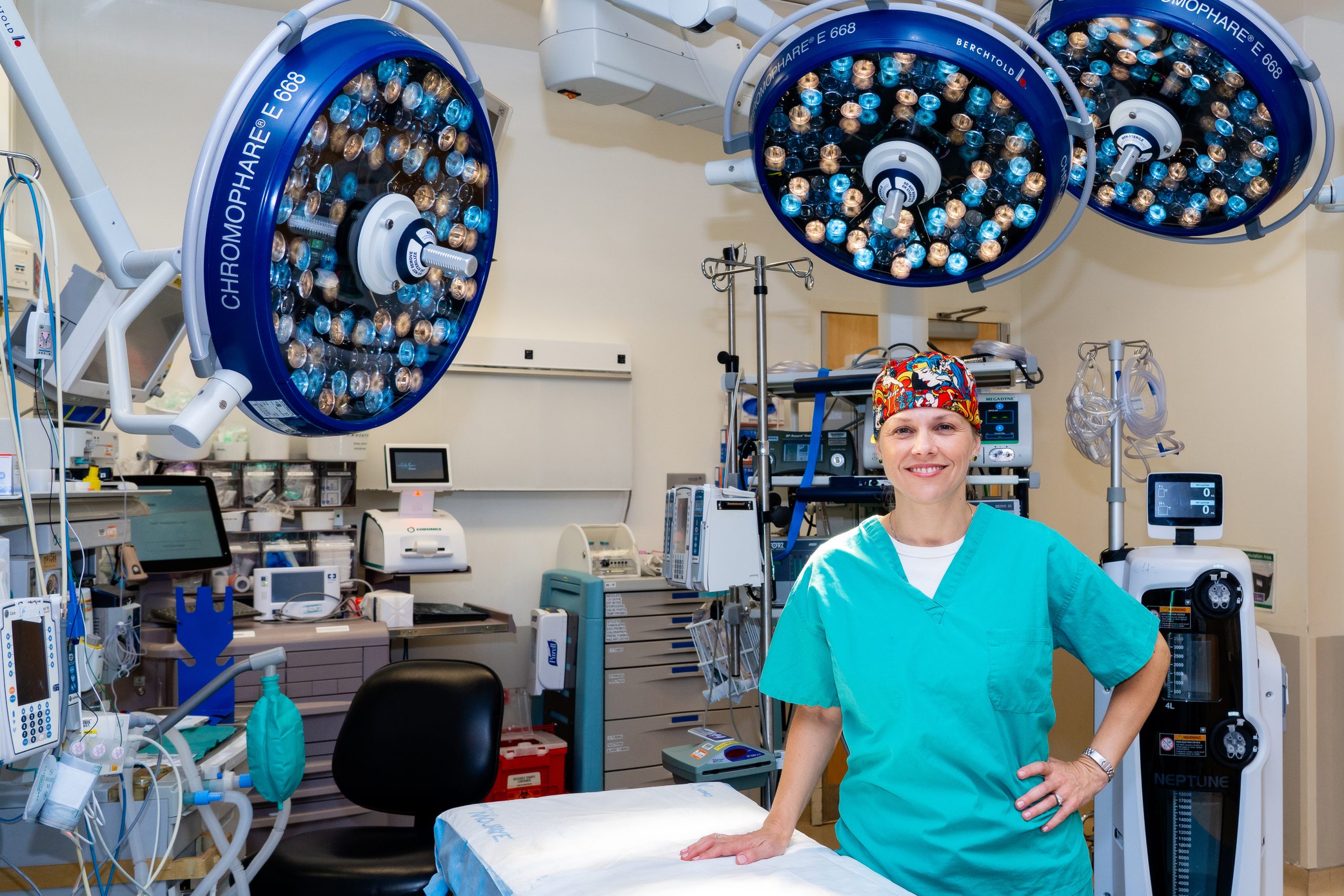
Muh came to MIT planning to pursue health policy, but ended up majoring in biology and political science, and earned a master's degree in political science before heading to Columbia University for medical school. Now she serves as the chief of pediatric neurosurgery and surgical director of the Pediatric Epilepsy Program at Maria Fareri Children’s Hospital and Westchester Medical Center in Valhalla, New York.
Kara Baskin | MIT Technology Review
December 8, 2025
Carrie Muh ’96, ’97, SM ’97 works in an office surrounded by letters from grateful parents. As the chief of pediatric neurosurgery and surgical director of the Pediatric Epilepsy Program at Maria Fareri Children’s Hospital and Westchester Medical Center in Valhalla, New York, Muh performs life-changing surgeries.
“I see parents who come into my office on their postoperative visit in tears because, for the first time, their child is able to talk or walk. Having a mom come in and say their child said ‘Mama’ for the first time is huge,” she says. Other patients can finally play sports after a lifetime of falls.
About 2% of kids have epilepsy, a neurological condition that can cause seizures, falls, and language issues. About 30% of pediatric epilepsy patients are resistant to the drugs available to treat the condition, but in some cases surgery can help. “Surgery can be such a huge game-changer. Even if it can’t cure them, it can significantly improve quality of life,” she says.
Muh came to MIT planning to pursue health policy. She majored in both biology and political science and then earned a master’s degree in political science. But after a summer interning at the White House, she saw a stronger opportunity for influence as a physician.
As a medical student at Columbia University, Muh got to observe the transplant of a heart from a child who had passed away to another child in need. That sparked her interest in pediatric surgery. “I was able to watch a surgical team save a child’s life,” she remembers.
She took a gap year during medical school to conduct brain tumor research at Columbia, shadowing neurosurgical residents and observing the precise poetry of their surgery. “I absolutely knew that was for me,” she says, adding that the need was also compelling. “There aren’t enough pediatric epilepsy surgery specialists in the country.”
Now patients often travel to Muh for laser ablation, which destroys the part of the brain responsible for seizures without damaging nearby healthy tissue. In other cases, she installs a vagal-nerve stimulator in a child’s chest, which can make seizures less frequent and intense. An additional option is to outfit a child’s brain with EEG electrodes to pinpoint areas of seizure activity; then she can treat those precise areas. For some children, a responsive neurostimulator—“a pacemaker for the brain,” she calls it—can stop a seizure in its tracks.
“Most of my research for the last five years has been on new ways to use technology to help more patients,” she says—younger people and those who have not traditionally been considered candidates for these devices.
Despite her workload, Muh finds time for Yankees games and Broadway plays with her three children. She also travels internationally to care for vulnerable patients. In April 2024, she performed some of the first pediatric epilepsy surgeries with deep brain stimulation in Ukraine. She was also scheduled to head to Kenya for similar work in September of this year.
But wherever she travels, she maintains strong ties to MIT as class secretary and as a former Undergraduate Association president. This reflects her outgoing nature, though she once doubted if she would fit in with the Institute’s intensely engineering-focused culture.
“My dad had gone to MIT and always told me how amazing it was. I loved engineering and science from a young age, so he thought I would obviously love MIT. But I didn’t know if I was ‘techy’ enough to go,” she jokes, even though in high school she did research at NASA’s Student Space and Biology program while juggling sports and theater commitments.
When she toured campus, though, she was hooked.
“I made lifelong friends at MIT and actually met my husband at the wedding of one of my sorority sisters,” she says. “I discovered MIT was a welcoming, open place. I tell my kids now: ‘I’m proud to be a nerd!’ Cool, passionate people are proud of the work they do and the things they love.”