
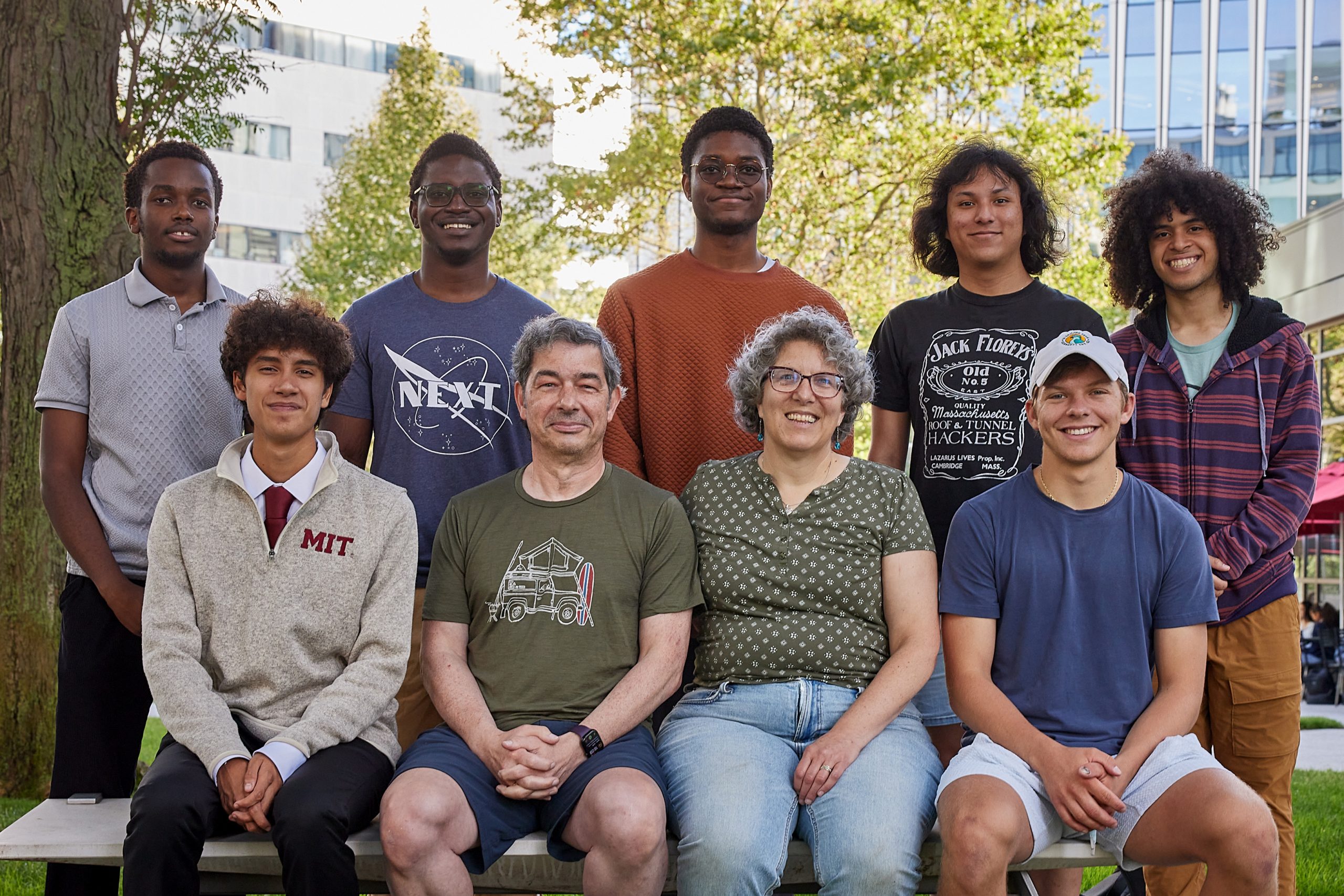
Franklin describes himself as an overachiever, so perhaps it’s not surprising that when he set out to become an educational counselor, one of the MIT alums who volunteers to interview applicants for undergraduate admission, he quickly started racking up record numbers.
Kathryn M. O'Neill | Slice of MIT
December 4, 2025
Michael Franklin ’88 describes himself as an overachiever. So perhaps it’s not surprising that when he set out to become an educational counselor (EC)—an MIT alum who volunteers to interview applicants for undergraduate admission—he quickly started racking up record numbers.
In his first year as an EC, Franklin did 96 interviews—a lot but not quite the most anyone conducted for the 2023–’24 admission cycle. The following year, he redoubled his efforts and earned the top spot. He did it again for students hoping to enter in 2025–’26, interviewing a whopping 160 candidates—nearly twice as many as the No. 2 interviewer.
Interviewing for MIT is a passion he shares with his wife, Debbie Birnby ’91, who conducted 44 interviews herself for students applying for this year. “We started doing this, and it turned out to be just amazing talking to people,” Franklin says. “There’s this glow about students when they talk about what they really like to do, and I enjoy seeing that.”
Birnby agrees. “You hear bad stuff on the news, and then you see young people and you have hope for the future,” she says. “They have so much energy and enthusiasm.”
A Huge Volunteer Corps
Educational counselors form one of the largest groups of MIT volunteers, with more than 7,500 people signed up during the 2024–’25 interview cycle alone. Many—like Franklin and Birnby—love it enough to come back year after year. Currently, MIT has more than 3,500 ECs who have volunteered for over five years and more than 2,000 who have been interviewing for over 10 years. Five ECs have been interviewing for over 50 years.
All play a vital role by helping MIT Admissions get a more holistic view of the candidates, according to Yi Tso ’85, the staff member who runs the EC program as director of the Educational Council. The average EC completes just about six interviews each year. So Franklin and Birnby—who also produce very informative reports on candidates, Tso emphasizes—really stand out: “They are clearly among our super-superstar volunteers.”
The couple’s large interview numbers are, in part, an accident of geography. ECs typically interview candidates who live near them, but when Franklin and Birnby decided to start interviewing in 2022, they were living in an area of Maryland without many MIT applicants. As a result, they took on interviews with “overflow” candidates—those without access to a local EC. They could conduct these interviews easily online, so the pair—who were both newly retired (Franklin was a software developer; Birnby was in lab technical service)—quickly got into a groove and just kept going.
Two years later, they moved back to the Boston area, “partly because we kept telling people how great Boston was, so we started believing it,” Franklin jokes. Since the area has a robust group of ECs, the couple—who by then had been named regional coordinators for the EC program in Boston—continued to interview students from the overflow list.
The Personal Touch
ECs start their work with very little information—just the student’s name, high school, and contact information—and EC guidelines recommend that they spend 30 to 60 minutes with each student. Birnby says she typically spends about an hour and a half. Franklin often takes even more time; he admits he happily spoke for four hours with one enthusiastic candidate. “You meet all these interesting people,” he explains, noting that he and his wife have heard students discuss a full range of interests and ambitions, including everything from competing in the sailing Junior Olympics to launching a national-scale desalination project.
ECs also answer questions from applicants, and both Franklin and Birnby say most students are eager to learn more about campus culture. “A lot of people don’t have a good idea about how weird and wonderful MIT is. It’s a really weird place in a totally good way,” Franklin says. He likes to tell students about the Banana Lounge, the Pirate Certificate, the Baker House piano drop, and other quirky traditions.
Both Franklin and Birnby hope they can help students find out if MIT will be a good fit for them—because that’s at the heart of why they care enough to give back to the Institute themselves. “At MIT I felt I had found my people. I fit there,” says Birnby, who was a biology major while Franklin studied political science. (She says they knew each other when they were both at the Institute but didn’t become a couple until decades later.)
Of course, most candidates ECs interview do not ultimately gain admission. Consider that for the 2025–’26 year, MIT admitted 1,334 undergraduates out of a competitive field of 29,282 applicants. Still, Franklin and Birnby have been able to congratulate several students each year. Today there are MIT students from all over the world—from North Carolina to Kyrgyzstan—who can say they were interviewed by one of them.
Mentors and Friends
Franklin and Birnby have made a point of keeping in touch with many of these students, who now count them as mentors and friends. The pair begin by congratulating students as soon as they can see who has been accepted, which is posted online. “We can’t see results until they see. So we’re like, check already!” Birnby says.
In the fall, they welcome the new students. Then they invite their admitted interviewees from all classes—a group that now numbers 55—to various gatherings throughout the year. In 2024, for example, the pair hosted 10 students for Thanksgiving at their house in Somerville.
“When I came to MIT, it felt so reassuring to know I always had someone to talk to and ask questions of during my MIT journey,” says Yumn Elameer ’28, whom Franklin interviewed. “I’m so grateful to have gotten Mike as an interviewer, to have gained him as a friend and as someone I know will always be there for help, a good laugh, or advice.”